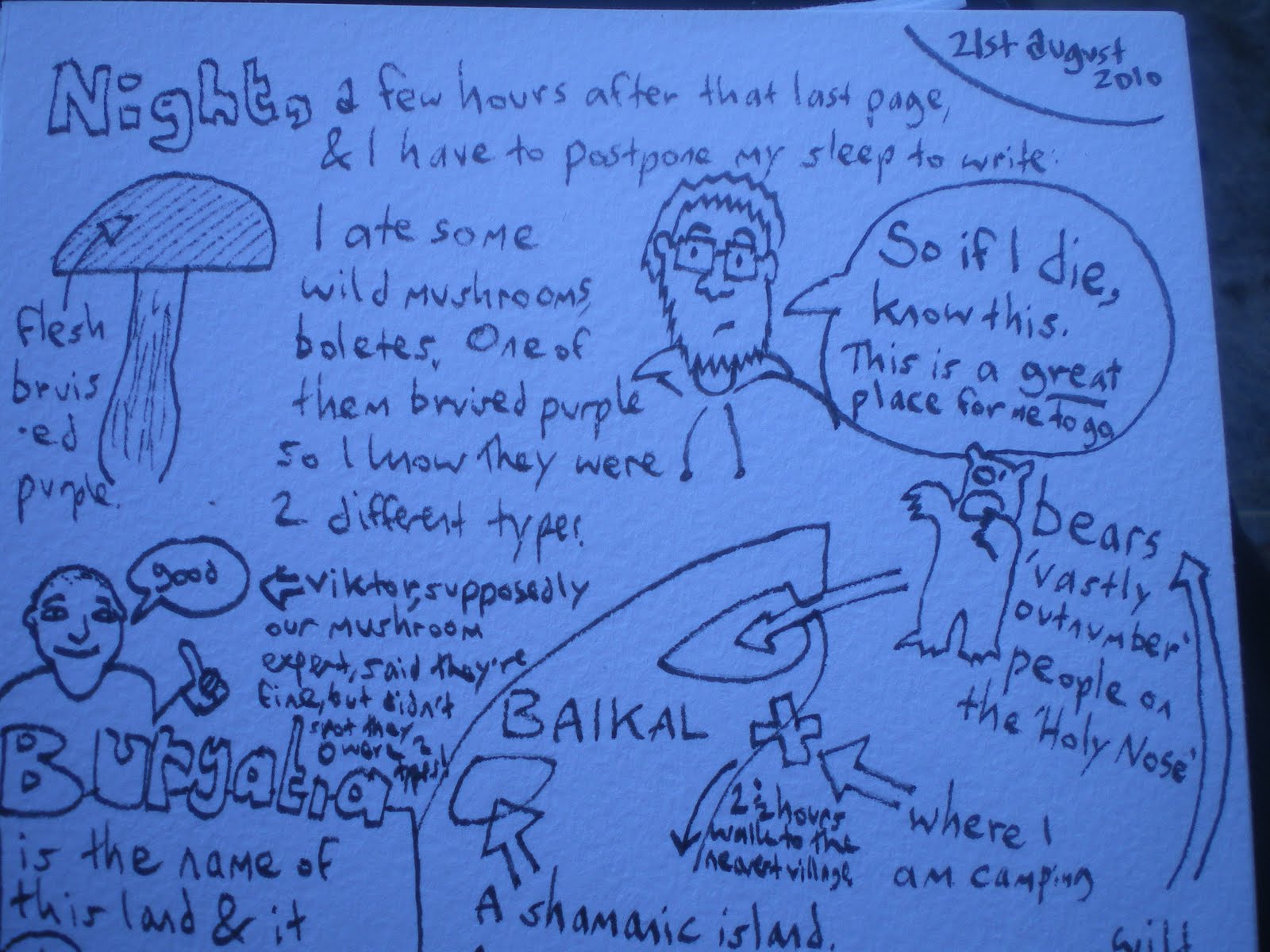
I've been drawing a cartoon diary while in Mongolia, available here.
Photos of Mongolia are on a temporary faecebook account here.
And photos of the Lake Baikal camp are also on the account here.
Sunday, 12 September 2010

Sunday, 5 September 2010
Into Outer Mongolia
I am currently on a detour from the Bakunin-Kropotkin route, into Mongolia with 4 others who did the conservation camp on Baikal. Tomorrow we're heading west to camp for a few days in an unknown place. It's 2 days away because we were advised that wild camping in the general vicinity of Ulan Bator and its nearest national parks is too dangerous. There's still marauders about.
Approaching the border I read about Kropotkin's bluffs and successful manouevres to get past official obstructions and into Chinese Manchuria. I myself was, strictly speaking, in breach of my Russian visa because the conservation organisation I camped with had failed to notify the right authorities that I was there. But another Austrian girl was in worse straits because someone had stolen her visa on the train.
We had 8 hours wait on the Russian side of the border, but in the end the only real (as opposed to imagined) difficulties we faced were the heat and the boredom. My registration slip was wordlessly collected and even the Austrian girl was okay - it was the Mongolian border guard's birthday.
So I'm no longer making notes for the anarchist pilgrimage zine, but will take them up again when I return into Russia, on the 17th September, when I mean to take another train straight away to Chita and the Amur River (where Kropotkin had his first job, and Bakunin escaped exile).
Until then, I am still drawing a diary, which I will probably post here, but there isn't much anarchist history in it.
The only way I am continuing the heritage of Bakunin is by borrowing money off people - the bank has stopped my card and so I've had to buy tickets etc... with the cash of new acquaintances. Bakunin continued to do it into his old age, and never paid back. But I think I'm too middle class for that.
Back in Ulan Bator on the 13th September.
Approaching the border I read about Kropotkin's bluffs and successful manouevres to get past official obstructions and into Chinese Manchuria. I myself was, strictly speaking, in breach of my Russian visa because the conservation organisation I camped with had failed to notify the right authorities that I was there. But another Austrian girl was in worse straits because someone had stolen her visa on the train.
We had 8 hours wait on the Russian side of the border, but in the end the only real (as opposed to imagined) difficulties we faced were the heat and the boredom. My registration slip was wordlessly collected and even the Austrian girl was okay - it was the Mongolian border guard's birthday.
So I'm no longer making notes for the anarchist pilgrimage zine, but will take them up again when I return into Russia, on the 17th September, when I mean to take another train straight away to Chita and the Amur River (where Kropotkin had his first job, and Bakunin escaped exile).
Until then, I am still drawing a diary, which I will probably post here, but there isn't much anarchist history in it.
The only way I am continuing the heritage of Bakunin is by borrowing money off people - the bank has stopped my card and so I've had to buy tickets etc... with the cash of new acquaintances. Bakunin continued to do it into his old age, and never paid back. But I think I'm too middle class for that.
Back in Ulan Bator on the 13th September.
Thursday, 2 September 2010
Train Journeys


I've booked tickets on the early train to Mongolia tomorrow, with Travis the lucky-in-love confederate boy, and Miss Freya Jones. We have packs of cards and high hopes, although my semi-illegality here now means I may be quizzed at the border (the delay at the border is approximately 7 hours).
Here are pictures from the 3 day train journey on the relatively luxururious 'Rossiya' train. I am proud of dragging people from my carriage out of their cabins and into the restaurant car for drinks. The two men are Waldemar the Finn and Alexandr the Russian. The station is Zima station, which means 'Winter'.




Ulan Ude as a base.


The words on the hill are in Cyrillic, en route to the Datsan, see if you can tell what they say.
The words on the Buddhist temple honour 'green tara'. Yes, the goddess is worshipped only in Buryatia.
The cyclists are a bunch of Germans, American, Polish etc.. we met by Lenin's disembodied head, calling themselves '2wheel4change' and cycling from Ulan Ude to Mongolia. Bunch of hippies - we met them a day before they were due to go to the Lake, after they did a juggling performance in the street. Next day they were still there in the square, still planning to do their performance. Next day they were there again. Good luck to them and all their bike grease.
The dog is blind, and called variously 'mole' or 'blindie' (in Russian). He has a real thing for chewing feet, arms, shoes etc.., and along with the 2 hostel cats has made this hostel a lovely place to be based.
Tuesday, 17 August 2010
Lake Baikal
In a few hours I go to Lake Baikal, where I will camp for 2 weeks on the shore, as part of a trail-building project of volunteers, both Russian and West European.
I have let the anarchist history-mapping fall a little lately, and instead I've been visiting the Buddhist Monastery, Ingoltsy Datsan, and seeing throat-singing and other nomadic music in Ulan Ude.
So I do of course promise to get it back on track when I return in 2 weeks. For now, I am just thinking of Kropotkin's formative experiences in Siberia, which taught him that the state commands nothing, progresses nothing, cannot be the leader of positive change and reform for people. Read what he said in his Memoirs of a Revolutionist, available here.
Here is one of his experiences of Lake Baikal, which encouraged he and his brother to leave the army:
"Several batches of Russian political exiles had been sent during the last century to Siberia, but with the submissiveness to fate which is characteristic of the Russians, they never revolted; they allowed themselves to be killed inch by inch without ever attempting to free themselves. The Poles, on the contrary, -- to their honor be it said, -- were never so submissive as that, and this time they broke into open revolt. It was evident that they had no chance of success, but they revolted nevertheless. They had before them the great lake, and behind them a girdle of absolutely impracticable mountains, beyond which spread the wildernesses of North Mongolia; but they conceived the idea of disarming the soldiers who guarded them, forging those terrible weapons of the Polish insurrections, -- scythes fastened as pikes on long poles, -- and making their way across the mountains and across Mongolia, towards China, where they would find English ships to take them. One day the news came to Irkútsk that part of those Poles who were at work on the Baikál road had disarmed a dozen soldiers and broken out into revolt. Eighty soldiers were all that could be dispatched against them from Irkútsk; crossing the Baikál in a steamer, they went to meet the insurgents on the other side of the lake.
The winter of 1866 had been unusually dull at Irkútsk. In the Siberian capital there is no such distinction between the different classes as one sees in Russian provincial towns, and Irkútsk "society," composed of numerous officers and officials, together with the wives and daughters of local traders and even clergymen, met during the winter, every Thursday, at the Assembly rooms. This winter, however, there was no "go" in the evening parties. Amateur theatricals, too, were not successful; and gambling, which usually flourished on a grand scale at Irkútsk, only dragged along; a serious want of money was felt among the officials, and even the arrival of several mining officers was not signalized by the heaps of banknotes with which these privileged gentlemen commonly enlivened the knights of the green tables. The season was decidedly dull, -- just the season for starting spiritualistic experiences with talking tables and talkative spirits. A gentleman who had been the pet of Irkútsk society the previous winter for the tales from popular life which he recited with great talent, seeing that interest in himself and his tales was failing, took now to spiritualism as a new amusement. He was clever, and in a week's time all Irkútsk society was mad over talking spirits. A new life was infused into those who did not know how to kill time. Talking tables appeared in every drawing-room, and love-making went hand in hand with spirit rapping. Lieutenant Pótaloff took it all in deadly earnest, -- talking tables and love. Perhaps he was less fortunate with the latter than with the tables; at any rate, when the news of the Polish insurrection came, he asked to be sent to the spot with the eighty soldiers. He hoped to return with a halo of military glory."
"I go against the Poles," he wrote in his diary; "it would be so interesting to be slightly wounded!"
He was killed. He rode on horseback by the side of the colonel who commanded the soldiers, when "the battle with the insurgents" - the glowing description of which may be found in the annals of the general staff - began. The soldiers were slowly advancing along the road when they met some fifty Poles, five or six of whom were armed with rifles and the remainder with sticks and scythes. The Poles occupied the forest and from time to time fired their guns. The file of soldiers returned the fire. Pótaloff twice asked the permission of the colonel to dismount and dash into the forest. The colonel very angrily ordered him to stay where he was. Notwithstanding this, the next moment the lieutenant had disappeared. Several shots resounded in the wood in succession, followed by wild cries; the soldiers rushed that way, and found the lieutenant bleeding on the grass. The Poles fired their last shots and surrendered; the battle was over, and Pótaloff was dead. He had rushed, revolver in hand, into the thicket, where he found several Poles armed with scythes. He fired upon them all his shots, in a haphazard way, wounding one of them, whereupon the others rushed upon him with their scythes.
At the other end of the road, on this side of the lake, two Russian officers behaved in the most abominable way toward the Poles who were building the same road, but took no part in the insurrection. One of the two officers rushed into their tent, swearing and firing his revolver at the peaceful exiles, two of whom he badly wounded.
">Now, the logic of the Siberian military authorities was that as a Russian officer had been killed, several Poles must be executed. The court-martial condemned five of them to death: Szaramówicz, a pianist, a fine looking man of thirty, who was the leader of the insurrection; Celínski, a man of sixty, who had once been an officer in the Russian army; and three others whose names I do not remember.
The governor-general telegraphed to St Petersburg asking permission to reprieve the condemned insurgents; but no answer came. He had promised us not to execute them, but after having waited several days for the reply, he ordered the sentence to be carried out in secrecy, early in the morning. The reply from St Petersburg came four weeks later, by post: the governor was left to act "according to the best of his understanding." In the mean time five brave men had been shot.
I have let the anarchist history-mapping fall a little lately, and instead I've been visiting the Buddhist Monastery, Ingoltsy Datsan, and seeing throat-singing and other nomadic music in Ulan Ude.
So I do of course promise to get it back on track when I return in 2 weeks. For now, I am just thinking of Kropotkin's formative experiences in Siberia, which taught him that the state commands nothing, progresses nothing, cannot be the leader of positive change and reform for people. Read what he said in his Memoirs of a Revolutionist, available here.
Here is one of his experiences of Lake Baikal, which encouraged he and his brother to leave the army:
"Several batches of Russian political exiles had been sent during the last century to Siberia, but with the submissiveness to fate which is characteristic of the Russians, they never revolted; they allowed themselves to be killed inch by inch without ever attempting to free themselves. The Poles, on the contrary, -- to their honor be it said, -- were never so submissive as that, and this time they broke into open revolt. It was evident that they had no chance of success, but they revolted nevertheless. They had before them the great lake, and behind them a girdle of absolutely impracticable mountains, beyond which spread the wildernesses of North Mongolia; but they conceived the idea of disarming the soldiers who guarded them, forging those terrible weapons of the Polish insurrections, -- scythes fastened as pikes on long poles, -- and making their way across the mountains and across Mongolia, towards China, where they would find English ships to take them. One day the news came to Irkútsk that part of those Poles who were at work on the Baikál road had disarmed a dozen soldiers and broken out into revolt. Eighty soldiers were all that could be dispatched against them from Irkútsk; crossing the Baikál in a steamer, they went to meet the insurgents on the other side of the lake.
The winter of 1866 had been unusually dull at Irkútsk. In the Siberian capital there is no such distinction between the different classes as one sees in Russian provincial towns, and Irkútsk "society," composed of numerous officers and officials, together with the wives and daughters of local traders and even clergymen, met during the winter, every Thursday, at the Assembly rooms. This winter, however, there was no "go" in the evening parties. Amateur theatricals, too, were not successful; and gambling, which usually flourished on a grand scale at Irkútsk, only dragged along; a serious want of money was felt among the officials, and even the arrival of several mining officers was not signalized by the heaps of banknotes with which these privileged gentlemen commonly enlivened the knights of the green tables. The season was decidedly dull, -- just the season for starting spiritualistic experiences with talking tables and talkative spirits. A gentleman who had been the pet of Irkútsk society the previous winter for the tales from popular life which he recited with great talent, seeing that interest in himself and his tales was failing, took now to spiritualism as a new amusement. He was clever, and in a week's time all Irkútsk society was mad over talking spirits. A new life was infused into those who did not know how to kill time. Talking tables appeared in every drawing-room, and love-making went hand in hand with spirit rapping. Lieutenant Pótaloff took it all in deadly earnest, -- talking tables and love. Perhaps he was less fortunate with the latter than with the tables; at any rate, when the news of the Polish insurrection came, he asked to be sent to the spot with the eighty soldiers. He hoped to return with a halo of military glory."
"I go against the Poles," he wrote in his diary; "it would be so interesting to be slightly wounded!"
He was killed. He rode on horseback by the side of the colonel who commanded the soldiers, when "the battle with the insurgents" - the glowing description of which may be found in the annals of the general staff - began. The soldiers were slowly advancing along the road when they met some fifty Poles, five or six of whom were armed with rifles and the remainder with sticks and scythes. The Poles occupied the forest and from time to time fired their guns. The file of soldiers returned the fire. Pótaloff twice asked the permission of the colonel to dismount and dash into the forest. The colonel very angrily ordered him to stay where he was. Notwithstanding this, the next moment the lieutenant had disappeared. Several shots resounded in the wood in succession, followed by wild cries; the soldiers rushed that way, and found the lieutenant bleeding on the grass. The Poles fired their last shots and surrendered; the battle was over, and Pótaloff was dead. He had rushed, revolver in hand, into the thicket, where he found several Poles armed with scythes. He fired upon them all his shots, in a haphazard way, wounding one of them, whereupon the others rushed upon him with their scythes.
At the other end of the road, on this side of the lake, two Russian officers behaved in the most abominable way toward the Poles who were building the same road, but took no part in the insurrection. One of the two officers rushed into their tent, swearing and firing his revolver at the peaceful exiles, two of whom he badly wounded.
">Now, the logic of the Siberian military authorities was that as a Russian officer had been killed, several Poles must be executed. The court-martial condemned five of them to death: Szaramówicz, a pianist, a fine looking man of thirty, who was the leader of the insurrection; Celínski, a man of sixty, who had once been an officer in the Russian army; and three others whose names I do not remember.
The governor-general telegraphed to St Petersburg asking permission to reprieve the condemned insurgents; but no answer came. He had promised us not to execute them, but after having waited several days for the reply, he ordered the sentence to be carried out in secrecy, early in the morning. The reply from St Petersburg came four weeks later, by post: the governor was left to act "according to the best of his understanding." In the mean time five brave men had been shot.
The insurrection, people said, was foolish. And yet this brave handful of insurgents had obtained something. The news of it reached Europe. The executions, the brutalities of the two officers, which became known through the proceedings of the court, produced a commotion in Austria, and Austria interfered in favor of the Galicians who had taken part in the revolution of 1863 and had been sent to Siberia. Soon after the insurrection, the fate of the Polish exiles in Siberia was substantially bettered, and they owed it to the insurgents, -- to those five brave men who were shot at Irkútsk, and those who had taken arms by their side.
For my brother and myself this insurrection was a great lesson. We realized what it meant to belong in any way to the army. I was far away, but my brother was at Irkútsk, and his squadron was dispatched against the insurgents. Happily, the commander of the regiment to which my brother belonged knew him well, and, under some pretext, he ordered another officer to take command of the mobilized part of the squadron. Otherwise, Alexander, of course, would have refused to march. If I had been at Irkútsk, I should have done the same.
We decided then to leave the military service and to return to Russia. This was not an easy matter, especially as Alexander had married in Siberia; but at last all was arranged, and early in 1867 we were on our way to St Petersburg"
Subscribe to:
Posts (Atom)
